



It’s a common misconception that there are few differences between Canary Islands.
In Part 1, we look at the most popular Canary Islands of Tenerife, Gran Canaria, Lanzarote and Fuerteventura.
Unless all you want to do is fly to one of the islands, stay in a hotel, and spend your days round the pool or on the beach and your nights in the nearest bar, the differences are very evident. For those who want to combine rest, relaxation and sun with the discovery of the essence of an island – its culture, food, landscapes and way of life away from tourism – simply move away from the purpose-built resorts.
You don’t have to travel far into the interior to find the many differences between Canary Islands. Equally, try visiting some of the less spotlight-hogging islands such as La Gomera, La Palma, El Hierro & La Graciosa which we cover in Part 2, for a very different Canary Island experience.
What creates differences between Canary Islands?
Less than 230km (143 miles) separates the eight Canary Islands east to west yet they have eight distinct personalities and eight individual landscapes.
Beginning in El Hierro and La Palma, the most westerly of the Canary Islands, and travelling east through La Gomera to the north of the islands of Tenerife and Gran Canaria, the landscape is lush, fertile, sub-tropical and green. By the time you get as far east as Lanzarote, Fuerteventura and La Graciosa, the landscape has morphed into virtual desert. There are areas of green to be found on both Lanzarote and Fuerteventura, but they are not the dominant landscape. Little La Graciosa, on the other hand, is as close as you’ll get to a tropical desert island without taking a long-haul flight.

West to east, tourism has had more impact on each successive island, so El Hierro gives very few concessions to tourism and consequently its landscape is completely unspoilt. The same is true of the bulk of La Gomera and La Palma where tourist resorts are confined to small coastal areas while the rest of the island has changed little over generations.
The best-known islands of Tenerife, Gran Canaria, Lanzarote and Fuerteventura may have tourism developments in common but there the similarity ends. Culturally and geographically, there are many differences between them, not least due to their climates.

The further west the island, the greater the amount of rainfall and conversely, the further east, the more arid the climate. The wind also plays a significant part in creating differences between Canary Islands. On the eastern islands of La Graciosa, Lanzarote and Fuerteventura, constant winds carry grains of sand formed from crushed seashells across the islands from existing beaches (Papagayo on Lanzarote and Corralejo on Fuerteventura) and from the Sahara, providing golden beaches across both islands.
While some of that sand finds its way onto the southern and eastern shores of Gran Canaria and Tenerife, the further west you travel the more volcanic the beaches are. Here, more rainfall and heavy Atlantic swells break down the volcanic rock creating dark sand.
On the western islands of El Hierro, La Gomera and La Palma, adequate rainfall ensures lush vegetation which makes travel through their interiors an arduous and time-consuming business; impossible for the development of mass tourism, perfect for hikers. The north of Tenerife also has adequate rainfall but it has the infrastructure to support the Canario population who live and work there. By association, that also supports tourism.

Perhaps the most influential of all the differentiating factors across the Canary Islands, is agriculture which creates some of the biggest differences between islands.
Again, travelling the islands from west to east, characteristic crops change significantly as rainfall levels decrease from those that are heavily rain dependant such as bananas, tropical fruits, avocados and tomatoes which dominate western Canary Islands, to those needing little water such as aloe vera, figs, vines and some potato varieties.
A snapshot of the differences between Canary Islands
Tenerife
Successive monocultures have dominated Tenerife’s landscape, from sugar cane post-conquest, through vines, cochineal and finally bananas, the face of the island morphing with each new crop.

Today, although every western island, along with Gran Canaria, has banana plantations, the greatest volume of them is on Tenerife which produces 40% plus of all the Canary Islands’ banana exports. Consequently, Tenerife’s coastal landscape, both north and south, is awash in the tattered green leaves of bananas swaying in the breeze or barely contained within their torn and flapping white polyethylene canopies.
Although the island’s southern and western coastlines have been over-developed for tourism, nothing was lost in the process. The island is climatically split north to south. Lush and fertile with adequate winter rainfall, it was predominantly the northern side of Tenerife that, prior to the advent of mass tourism in the 1960s and 1970s, was populated. Even today, the area frequently condemned for over-tourism is a small fraction of the island’s surface area. In the south, smart hotels, manicured beaches and myriad bars and restaurants are geared entirely towards its invaluable tourism sector.
Move north and you’ll find traditional towns and villages, colonial architecture, a vibrant capital and a rich culture. You’ll also experience rainfall in winter and black sand beaches. One island, two very different faces.

Dominating the entire Canarian archipelago, and lending Tenerife a unique profile, is Mount Teide, Spain’s highest mountain and the planet’s third largest volcano. Rising from the centre of Tenerife and visible from every other island, the volcano sits in a vast caldera (crater) of volcanic cones, characterised by solidified rivers of molten lava; black, shiny obsidian fields, and kaleidoscopic cones of russet, gold and purple, this is an extraordinary landscape unlike any other in the Canary Islands, or indeed in most of the world.
In late spring, the landscape takes on an even more surreal nature as the fat, 3-metre-high spikes of Tajinaste Rojo come into bloom. Surrounding Teide National Park, a corona of dense forest provides stark contrast to the island’s volcanic heart and in the north and west, marks the transition to hill settlements and rural fincas enroute to the palm-filled coastline.
Gran Canaria
Popularly known as ‘a continent in miniature’, Gran Canaria’s stunning landscape carries features of every other island from its mountainous interior which resembles western islands, to its desert-like sand dunes and pale southern beaches which emulate the eastern Canary Islands. But Gran Canaria has a strong culture and personality all of its own.
Its vibrant capital of Las Palmas has a young, Latino feel where the ancient Vegueta quarter blends seamlessly with beach life on its fabulous Las Canteras beach. There are surprises to be discovered around the island, like its coffee plantation in Agaete Valley, the most northerly in the world, where they produce gourmet coffee. Then there’s the Arehucas rum factory in the northern hill town of Arucas, and the pretty resort of Puerto de Mogán whose canals have earned it the nickname, Little Venice.
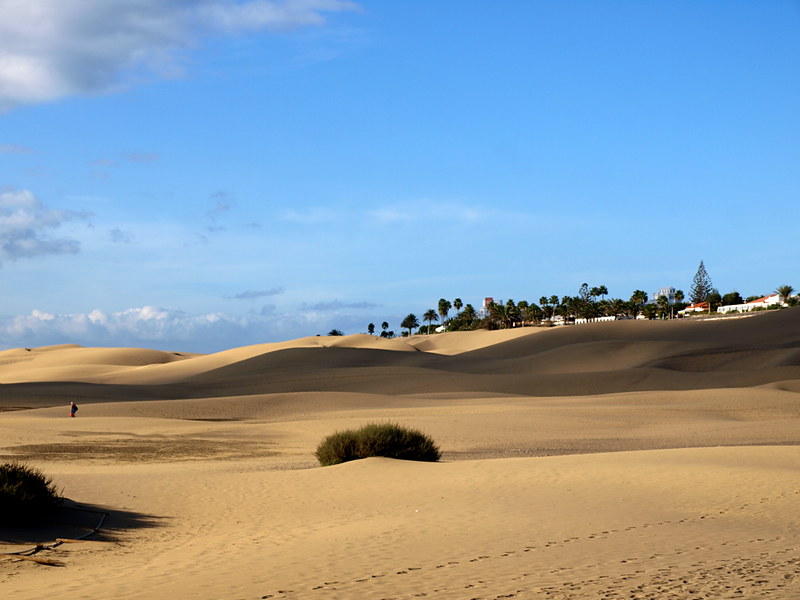
Much better known but none the less spectacular for that, are the sand dunes of Maspalomas that just cry out to run barefoot, and in allocated parts, bare everything, across them.
Without a dominant peak to hog the limelight, its mountainous interior provides breathtaking views over infinite peaks, and spectacular hiking. Its pine forests and palm groves contain multiple reservoirs built in the 1950s, whose boundaries have been so weaved into the landscape that you’d swear they were naturally occurring lakes. More than any other island, they provide a beauty to Gran Canaria’s hinterland that can stop you in your tracks.

Lanzarote
Lanzarote’s landscape has been formed by the world’s longest eruptive incident. In 1730, a volcanic eruption from Timanfaya blocked out the sun for six years and left a quarter of the island covered in volcanic ash and fallout. Eleven villages had been destroyed, and the once-fertile land had become barren malpais (literally, badland). Today, the Timanfaya volcano still burn at 600°C just below the surface and provides barbecued chicken and fire-starting entertainment for the visitors.
Every Canary Island except Fuerteventura and La Graciosa grows vines commercially and produces quality wine. But Lanzarote takes pole position on the wine quality league table for its award-winning and historic Malvasia wine which has been lauded since Shakespeare’s day.

Due to the volcanic nature of Lanzarote’s terroir, combined with the constant winds, tender vines grow in the centre of circular pits of black volcanic earth, protected from the prevailing wind by low, semi-circular walls. The method requires the vines to dig deep for moisture while remaining protected from the wind. The resultant wine is sweet, mineral-rich, and unique while the growing pits are arrestingly beautiful.

The other major influence on Lanzarote’s landscape is the extraordinary legacy of César Manrique, the island’s celebrated architect, artist and environmentalist. It was Manrique who expounded using only the natural resources found on the island to create the single-storey, white volcanic stone construction of houses across the island. His silver sculptures and ethereal wind toys effortlessly blend nature with art.
Fuerteventura
Anyone who’s ever visited Fuerteventura, oldest of the Canary Islands, may be surprised to learn that its now barren interior was once cloaked in dense forests that covered its central plains. But post-conquest in the early 15th-century, unchecked deforestation to supply wood for shipbuilding and domestic use, led to the decimation of its soil retention ability. Strong prevailing winds and a lack of rainfall ensured the forests could never regenerate, leaving the stark landscape that prevails today.
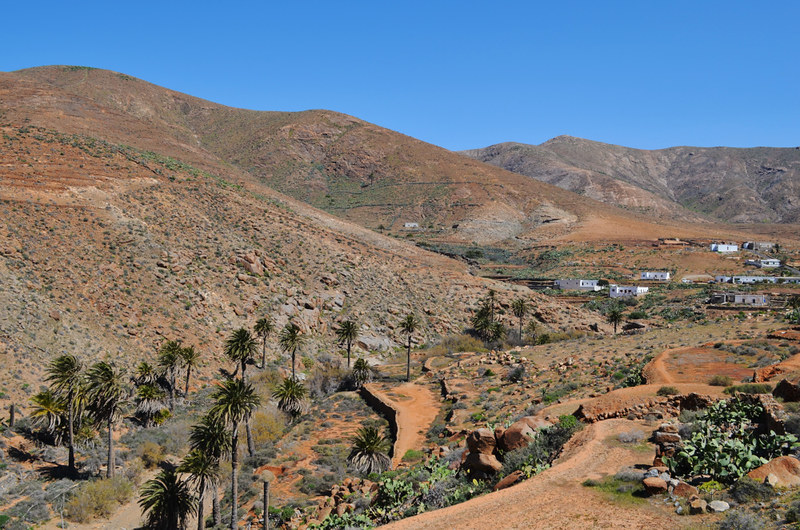
Fuerteventura is the most African of all the Canary Islands, its volcanic cones worn smooth by millennia of near-constant winds which have created a hypnotic beauty whose colours morph as the sun moves daily across the firmament. With limited opportunities for agriculture, apart from its sun-worshipping visitors, the island has more goats than people, and more Barbary squirrels than goats. Move anywhere in the interior landscape and one or both will probably be in the picture.

Coming out of the amber desert of its volcanic interior, the sight of hundreds of thousands of aloe vera plants in full bloom burns the retinas. Known as Lily of the Desert, a sea of razor-sharp, bulbous red leaves fans out below slender, yellow flowering spikes. It’s quite the contrast to the island’s acres of tomato plantations and its proliferation of windmills, but they are all perfectly suited to an island dominated by sunshine and wind.
In Differences Between Canary Islands, Pt 2, we look at the smaller, less well known islands of La Palma, La Gomera, El Hierro & La Graciosa


[…] 58 seconds ago7 min readAdd comment Written by Andy Share this article FacebookXRedditPinterestEmail Next article Differences Between Canary Islands, Part 1 […]