

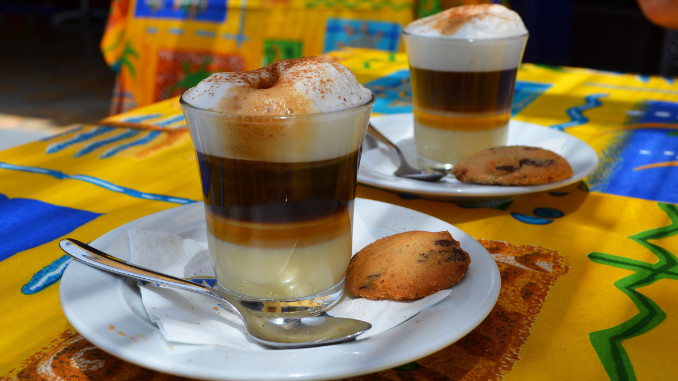

Think you know what a barraquito is on Tenerife? Ordering Tenerife’s speciality coffee might not be as straightforward as you think.
Do you know what a barraquito, Tenerife’s speciality coffee, is? Are you sure? 100% sure? Because, depending on where you are on Tenerife, and even sometimes from café to café, what a barraquito is can change.

Barraquito as we think we know it
It’s claimed the barraquito was created in the Bar Imperial in Santa Cruz sometime in the mid-twentieth century. The story goes a mariner known as Barraco requested the barman make him a coffee consisting of coffee, condensed milk, a splash of alcohol, and a dash of lemon peel. Other curious customers tried it, loved what they tasted, and so the barraquito was born.
The modern barraquito
There can be slight variations, but basically a barraquito is a seductive looking speciality coffee consisting of distinct layers . . . when made properly. We instantly judge the barraquito-making competence of any barista by how sharp the layers are.
From bottom up, first is condensed milk, then Licor 43 (it has to be Licor 43), followed by espresso coffee, milk, and finally foamed milk. The finishing touches are a small segment of lemon peel (sometimes lime), and a sprinkling of cinnamon. There are recipes which say a coffee bean can be added as a decorative touch, but we can’t remember ever seeing this.

How to drink it
A barraquito is served in a glass so that we can admire its transient beauty for a few moments. Some places have speciality glasses which enhance the visual impact.
It seems like a crime, vandalising a work of art, but the best way to enjoy a barraquito is to dunk the slice of peel and stir, combining the distinctive levels. It doesn’t stay warm long, so get it down quite quickly.

Geographical variations
So far, so simple. This is where it’s about to get messy. In some parts of Tenerife, a barraquito isn’t a barraquito, it’s a zaperoco. Why? Who knows? And why zaperoco? Zaperoco is more of a Latin American word than Castilian Spanish, which might be a clue. It means an uproar, a disorder, and is used to describe a scandal, a fight, or a commotion. Basically, it could be described as mixing things up, just what you do with a barraquito . . . I mean zaperoco.
It’s a name applied in some areas along Tenerife’s north coast, but not exclusively as we’ve had plenty of ‘barraquitos’ in Puerto de la Cruz. That’s the first complication. Although Licor 43 was an essential ingredient for el Barraco, it’s not always guaranteed your barraquito will automatically have Licor 43 in it. To be sure of that zap of alcohol, order a ‘barraquito especial’ or ‘barraquito completo.’ We’ve found that ordering a ‘barraquito con’ also does the trick.

If that’s all as clear as mud, here’s an example of the confusion that can exist when trying to order what we generally accept as a barraquito with Licor 43. Ironically, the least confusing places to order one is in those areas which get the most tourists. Bars there tend to know when a visitor asks for a barraquito what they really want is the classic.
When we ordered barraquitos in the south, and even in some bars in Puerto de la Cruz, that’s what we got. It was around other parts of the north that it became more of a lottery. Whenever we’re in La Villa shopping centre, we like to take time out for a coffee at the central kiosk there. It has a sign which helpfully makes what’s what clear. A barraquito doesn’t have Licor 43, whereas a zaperoco is classed as a ‘barraquito + licor’. Similarly when, out of habit, we ordered ‘barraquito con’ in a bar in Santa Úrsula, we were gently admonished, and told, ‘No es barraquito, es zaperoco.’ But then, just to zaperoco the water, when we ordered zaperocos in a bar up a side street in La Laguna, they arrived sin Licor 43. Go figure. On the socials, locals have heated debates about the differences, which is why we will stick with ‘barraquito con.’
Island variations
Although originally a speciality coffee in Tenerife, the other Canary Islands have now got in on the act, so it is widely available throughout the archipelago, sometimes with slight variations. Apparently, in the eastern islands of Lanzarote and Fuerteventura, there are iced barraquitos. On Gran Canaria, it’s said that banana liqueur can be used instead of Licor 43. On the western islands of La Palma, La Gomera, and El Hierro, barraquitos are sweetened further by the addition of miel de palma (palm honey). I know that there was an enforced name change and it is now called sirope de palma (palm syrup), but it will also be miel de palma to us. We’ve also had it a couple of times on La Palma with a dollop of cream on top. It is too much.

It’s not unique
It’s nice to think this speciality coffee originated on Tenerife, but it probably didn’t. A popular coffee in Cartagena is the Asiatico, a layered drink consisting of condensed milk, alcohol, espresso coffee, cinnamon, and a twist of lemon peel. Sound familiar? It was introduced to bars by sailors who’d got used to it on voyages to the Philippines. Sailors in Cartagena, a mariner in Santa Cruz. The similarities pile up. Tenerife’s are still the best though.
Leave a reply