


When Andy was Canary Islands specialist for The Telegraph, she reviewed hotels across the archipelago, awarding each a rating for location; style and character; service and facilities; rooms; food and drink; and value for money. Their relationship with their surroundings wasn’t part of the review. That might not seem important, and it’s something I don’t automatically consider, except when it jumps out at me and slaps me across the chops.

The first time this happened was with The Abama at Playa de San Juan. As we drove west shortly after it was built, our jaws hit the floor when we saw what looked like an immense Moorish citadel. I think the Abama’s design is attractive, but there’s nothing remotely Canarian about it. A couple of years later, we interviewed the Abama’s marketing manager at the time. She bristled when Andy remarked on its gargantuan size, replying ‘We prefer to think of it as being comprised of a series of small, intimate spaces.’ That’s marketing speak for you.
The Gran Meliá Palacio de Isora, part 1
When the Gran Meliá Palacio de Isora was under construction, we were worried it would be another luxury hotel that stood out like a sore thumb. It was a pleasant surprise to see it was relatively low-rise with buildings of a similar colour to jablé, so that it blended nicely with the surrounding terrain.

We stayed Red Level at the hotel and were very impressed with rooms, facilities, restaurants, and bars. Its central courtyard had the vibrancy of a stylishly sophisticated real plaza. As part of the stay, the hotel’s marketing manager gave us a tour. Meeting hotel directors and/or marketing managers is often part of the deal when travel writers review any hotels or stay in them as part of a commission. The Palacio de Isora’s marketing manager did something no other had done before or has done since; she took us outside of the hotel to talk about the impact on the local community.
Anyone who remembers that part of Alcalá’s coastline pre-luxury hotels days will recall it was basically rocky with few facilities. The hotel was instrumental in changing that. Since its construction, it had worked with the local authorities to develop the area, almost as a thank you for being able to share the coastline. Sea pools were spruced up, walkways built, and beaches created. It was a symbiotic relationship which seemingly benefited everyone.

The Gran Hotel Taoro, part 1
Iconic is an oft-used word in travel writing, but the Gran Hotel Taoro overlooking Puerto de la Cruz is deserving of the term. It was Spain’s first luxury hotel and can count kings, dukes, and Agatha Christie among those who have stayed there. Despite the lofty standing of some guests, caladoras (lace-makers) from Puerto would gather in the grounds or outside the front entrance to ply their trade. I have a friend who actually remembers this practice still going on when she was a young girl staying at the hotel.
During our time in Puerto, the Taoro wasn’t a hotel. But we still visited regularly, mostly for a wander around the grounds. One occasion was to interview Dr Simon Day at a Cities on Volcanoes Conference. He was the scientist who caused a stir in a 2000 Horizon programme by claiming a part of Cumbre Vieja on La Palma was likely to fall into the sea, creating a mega-tsunami that would engulf America’s eastern seaboard. Dr Day was fascinating. After interviewing him, and finding out how much the story had been sensationalised, we felt reassured we weren’t about to be engulfed by a mega-tsunami any time soon. I notice the ‘La Palma slipping into the sea’ stories are doing the tabloid rounds again, as though it’s something new. Even when not operating as a hotel, the Taoro felt like a part of Puerto de la Cruz.

The Gran Meliá Palacio de Isora, part 2
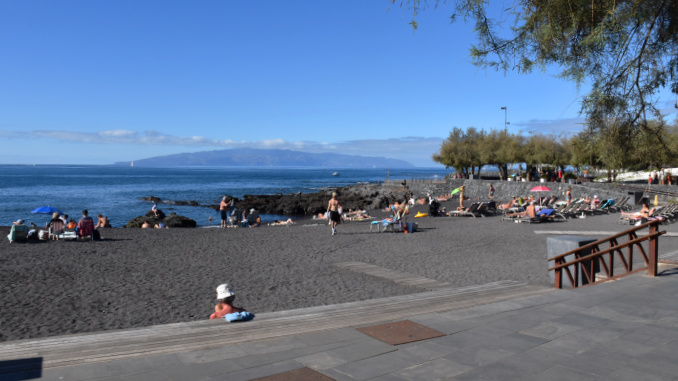
This year, while walking the coastal path from Playa de San Juan to Playa de la Arena (a new addition to our complimentary coastal routes part of our Island Walks), our route took us along the promenade in front of the Palacio de Isora. The seafront buzzed with local families enjoying themselves and muchachos playing basketball in a purpose-built court, while sunbathers lounged on the beaches and wallowed in the smart rock pools. It was an uplifting example of how the presence of a hotel can enhance a town rather than detract from it.
The Gran Hotel Taoro, part 2
It was very welcome news when the Gran Hotel Taoro reopened in 2025. There have been numerous travel articles since, praising hotel, staff, rooms, and food, some of it overseen by famous Basque chef Erlantz Gorostiza, also head chef at the Abama’s two Michelin star M.B. From the glowing reviews, it sounded like a perfect addition to Puerto’s hotel scene. We were keen to see the historic hotel again, especially in its restored state.

The approach to the Gran Hotel Taoro via Parque Taoro didn’t bode well. The Taoro Gardens appeared more neglected since the last time we strolled through them. Things got worse when the hotel came into view. It still looked like the Taoro we knew, albeit a more pristine version than we’d seen previously. However, the wall directly below it was in dire need of some TLC. It was scruffy, with damp-stained paintwork and peeling plaster. Approaching on foot, this is the first impression of a luxury hotel. It’s not a good one. It immediately set-off alarm bells, arousing suspicion there was little connection between the hotel and the area surrounding it. This was reinforced after we reached hotel level. Around the Taoro are concrete walls and ramps, as well as gated steel fences. To us, it felt aloof and unwelcoming, no longer the sort of place where you could imagine local artisans selling their intricate and delicate lace. It was disappointing.
I’ve no doubt the Gran Hotel Taoro is a fabulous hotel to stay in; I just wish the owners had taken a leaf out of Gran Meliá’s book and embraced the relationship with its surroundings when resurrecting a piece of Puerto’s history.


Leave a reply