

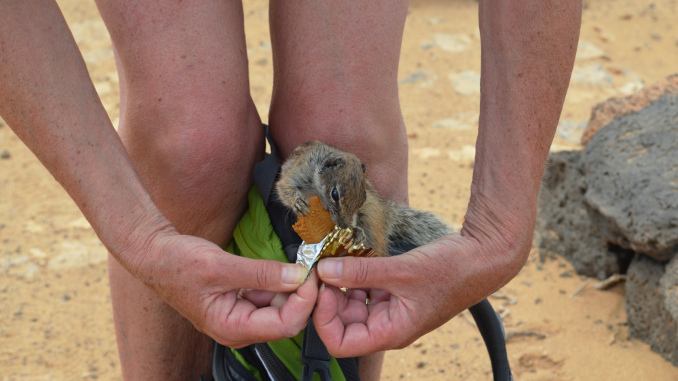

On Fuerteventura, the Barbary Ground squirrels have become almost as big a tourist attraction as the island itself. But they’re an invasive species.
Recently, I was compiling short guides for a couple of new Rough Guides publications and in one of them, I mention the cheeky Barbary ground squirrels that populate Fuerteventura.
The first time Jack and I visited Fuerteventura, we began as we always do, with a visit to the tourist office to gather as much information as we could before designing an itinerary that would hopefully give us a comprehensive overview of the entire island. The woman at the tourist office in Puerto del Rosario was proving extremely helpful and informative and we were happily conversing in a mix of Spanish and English until she mentioned a word we were not familiar with – ardillas. As we were clearly baffled, she translated to English for us; ‘skweerels’, she proudly announced.

Jack and I looked at each other and asked if she could repeat the word. Multiple times she said ‘Skweerels, skweerels, skweerels,’ sometimes pronouncing it really slowly like she was talking to someone with learning difficulties. Finally, we got it. Suffice to say, ‘squirrel’ is very difficult for native Spanish speakers to pronounce.
Barbary Ground Squirrels on Fuerteventura
Barbary ground squirrels were first introduced from Africa in 1965 when a single pair were brought in as pets. When one escaped confinement, the other was released to follow it. As Fuerteventura’s volcanic, arid, rocky terrain is not unlike the Barbary ground squirrels’ native home of the High Atlas Mountains in Morocco, just 60 miles away, the squirrels quickly adapted to their new home and began to breed.

From that first pair, the squirrels have colonised pretty much the entire island which now has an estimated Barbary ground squirrel population of one million and rising.
Unfortunately, they are an invasive species and are known to be harmful to some of the island’s endemic seeds and to ground-nesting birds whose eggs they steal. There are signs all over Fuerteventura asking tourists not to feed the squirrels, but the task is proving impossible. People love the cheeky little chaps because, let’s face it, they’re adorable.
Only about 6 inches long and as light as air, the Barbary ground squirrels dart about the place at lightning speed and have become very tame. They’ll happily crawl all over you to get into a pocket or a rucksack where there may be a stray biscuit or a crisp and they’ll willingly feed from your hand. But try to break a biscuit into small pieces for them and you’ll be mugged for the whole biscuit.

Although many people refer to them as chipmunks, Barbary ground squirrels are not chipmunks. Chipmunks have distinctive stripes along their faces and over their eyes whereas Barbary ground squirrels have a single stripe on their sides. While Barbary ground squirrels thrive in arid scrubland and rocky terrain, woodland and forest are the preferred terrain of chipmunks.
Long-term survival
Ever since they first colonised Fuerteventura, irresponsible humans have tried to smuggle Barbary ground squirrels onto other islands in the archipelago with varying degrees of success. Squirrels have been captured on Lanzarote and Gran Canaria, but it’s not thought the species has established a stable colony anywhere outside Fuerteventura.
When coach tours stop at the Risco de las Peñas viewpoint, despite the spectacular views across the Las Peñitas reservoir, Barranco de Mal Paso and Montaña de la Teta, it’s the hundreds of Barbary ground squirrels that steal the attention. Oblivious to the proliferation of signs in Spanish and English asking people not to feed the squirrels, tourists generously donate food to dozens of them scampering up and down the cliff with crisps and biscuits clamped in their mouths.

With few natural enemies other than cats, and only the island’s propensity towards the use of pesticides in the way of man-made defences, there seems little hope of containing them now. Their long-term survival seems assured.


Leave a reply